
When matter is displaced from its original use, it finds new ways of existing.
It is within this territory of transformation that the dialogue between Daniel Mattar and Kim Courbet takes shape. The affinity between the two artists became evident over the course of a year of weekly conversations, in which processes, questions, and discoveries were shared, gradually revealing a common field of investigation.
In Kim Courbet’s work, architectural fragments on the verge of disappearing are given new life. Planks, joints, and structures imbued with memory return to space as authored furniture. This is not about restoring what once was, but about reinventing possibilities. Her pieces balance permanence and renewal, asserting a careful relationship with matter and its temporalities.
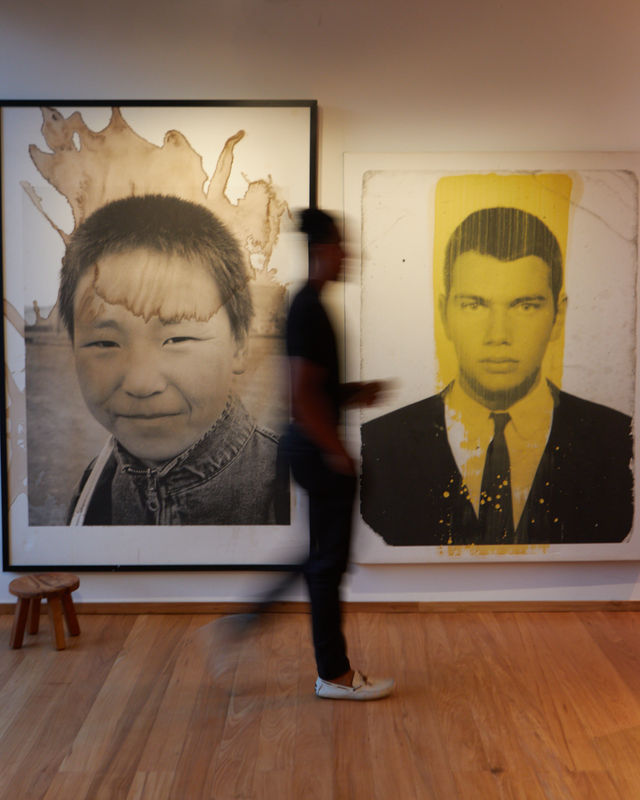
Daniel Mattar starts from the microscopic to create large-scale presences. Pigments, paint droplets, textures, and small formations are worked with precision before being expanded through macrophotography. This expansion reveals surfaces that vibrate between painting, sculpture, and image. Here, the photographic does not document; it fabricates sensitive territories that invite the viewer’s gaze to move closer.
The construction of the project includes the participation of Bebel Moraes, director of Brisa Galeria, who closely follows the artists’ conceptual development and the articulation between works and space. Her presence weaves together the research processes and guides the way they encounter one another within the exhibition environment.
Founded in Lisbon, Brisa arrives in Rio de Janeiro — the hometown of its founders — reaffirming its commitment to the exchange of practices and contexts.
In this pop-up, the gallery assumes a dual role. Beyond the exhibition, over the course of four days, Daniel Mattar and Bebel Moraes develop a new chapter of the Black Canvas Project, a research they have shared for over a decade — an itinerant studio that celebrates real encounters. Using analog equipment, photography becomes an act of coexistence. Each image is the result of this shared time.
Thus, Brisa Galeria’s presence in Rio is not limited to bringing together works; it proposes a space of artistic coexistence, where encounters, exchanges, and collaborations are built through experience and presence.
